


















































1993 Mercedes SL: The year of quiet revolution
 Added on: August 18, 2025
 Author: OctoClub
1. 1993 Mercedes SL: Subtle updates
4. The one-off Karmann Gullwing
1993 Mercedes SL: Subtle updates
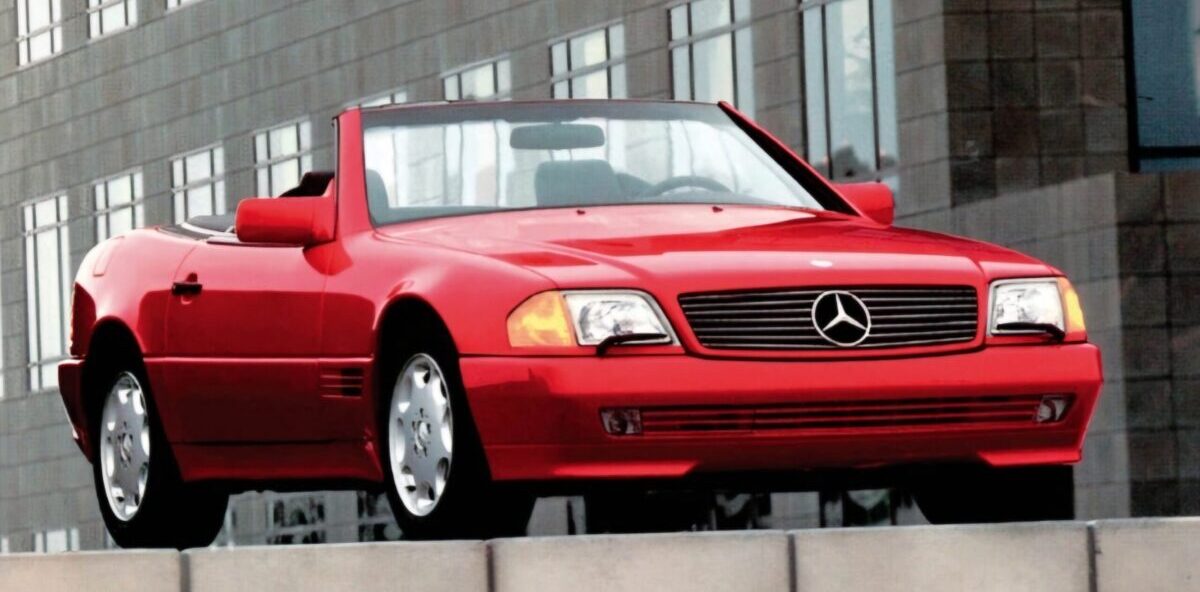
The 1993 model year didn’t bring sweeping mechanical changes across the SL range, but the 500SL received a noteworthy upgrade under the hood. In September 1992, Mercedes introduced the new M119.972 V8 engine, changing the chassis code to 129.067. While its displacement remained unchanged at 4973cc, the engine was extensively reworked, featuring a revised crankcase, a redesigned exhaust manifold, and—most importantly—a move to the more advanced LH-Jetronic port injection system. This transition brought the 500SL in line with the technology already used on the flagship V12, improving efficiency, emissions compliance, and drivability.
The upgrade was subtle at first glance, but for enthusiasts and engineers alike, it marked an important evolutionary step: a blend of traditional Mercedes durability with modern electronic precision, setting the stage for the SL to remain competitive well into the 1990s.

Engine upgrades
While displacement remained at 4973cc with a 10.0:1 compression ratio, Mercedes revised the crankcase design and reworked the exhaust manifold. The most significant change, however, was the switch from Bosch KE-Jetronic to LH-Jetronic port injection, a system already proven on the V12. This update introduced electronic hot-wire air-mass metering and more efficient injectors, now with two spray holes instead of four for improved fuel atomization.
The result? Slightly less peak power, down by 6 bhp, but a meaningful torque increase of 15 lb ft, bringing the figures to 320 bhp at 5600 rpm and 347 lb ft at 3900 rpm. More importantly, the new engine sailed through EURO 1 emissions regulations, proving Mercedes’ commitment to balancing performance with efficiency.
Interestingly, while real-world efficiency improved – fuel consumption dropped from 10.1 l/100km to 9.6 l/100km (around 29.4 mpg imperial / 24.5 mpg US) – the official 0–100 km/h (0–60 mph) time was adjusted slower, from 6.2 seconds to 6.5. Many believe this was done to keep the V12-powered 600SL looking more attractive on paper.

Styling and options
By October 1992, Mercedes had also refined the SL’s safety and luxury features. Dual airbags became standard, and Continental CTS tires were dropped from the options list.
Pricing at the time placed the 300SL at €55,940, with the 24-valve version costing an extra €3,670. The 500SL was priced at €78,530, while the flagship 600SL demanded €142,080 – highlighting just how exclusive the V12 truly was.
Mercedes also expanded customization. Buyers could now opt for:
-
A six-CD changer (€500)
-
Hardtop deletion, which reduced the invoice by €1,400
-
New Exclusive leather trims with contrasting piping (from €3,790 to €5,490 depending on the model)
By January 1993, prices had climbed again: the 300SL now started at €57,680, while the 600SL topped the range at €111,560. The six-litre car gained tinted glass as standard, while laminated options became no-cost extras.
Among the new luxury touches was an automatic dimming rearview mirror (€190), standard on the 600SL, while the outside mirror memory function jumped to €460. The alarm system also gained an immobilizer, raising its price to €495.

The one-off Karmann Gullwing
1993 also saw the debut of a fascinating one-off: a 300SL-24-based Gullwing built by German coachbuilder Karmann. While the firm filed for bankruptcy in 2009, it was rescued by Volkswagen, and this unique SL still exists today as a testament to 1990s automotive creativity.
Legacy of the 1993 SL
Beyond the numbers, the 1993 SL cemented Mercedes’ ability to refine rather than reinvent. Small engineering tweaks, subtle luxury updates, and carefully curated options gave buyers a sense of progress without losing the core character of the R129.
For enthusiasts today, the 1993 models mark a sweet spot – blending classic engineering with early steps toward modern efficiency, all wrapped in one of the most elegant roadsters of the era.
Q: What makes the Mercedes-Benz R129 500SL with the M119 V8 engine distinctive?
A: The M119 is a naturally aspirated V8 known for its smooth power delivery, strong torque and robust engineering. Its combination of performance and refinement makes the 500SL one of the most balanced versions of the R129.
Q: What was the difference between KE-Jetronic and LH-Jetronic fuel injection?
A: KE-Jetronic uses a mechanically controlled continuous injection system with electronic correction, whereas LH-Jetronic relies on electronic control and a hot-wire air-mass sensor to determine fuel delivery. The latter allows more precise mixture control and improved adaptation to changing engine conditions.
Q: Why did Mercedes-Benz revise the M119 engine without increasing its displacement?
A: The changes focused on improving combustion control, torque delivery, emissions performance and overall efficiency rather than increasing engine capacity. This allowed Mercedes to meet stricter emissions requirements while retaining the V8’s established character.
Q: How does the M119 V8 compare with the V12 engine in the R129 600SL?
A: The M119 V8 offers a strong balance of performance, mechanical simplicity and refinement. The V12 prioritises exceptional smoothness and effortless power delivery, but its additional cylinders and more complex construction generally result in higher maintenance demands.
Q: What should buyers inspect when purchasing a Mercedes-Benz R129 with an M119 engine?
A: Buyers should pay particular attention to the wiring harness, engine oil leaks, cooling system, fuel injection components and ignition system. A documented maintenance history and inspection by a Mercedes-Benz specialist can help identify expensive problems before purchase.
Q: What makes the 1993 Mercedes-Benz R129 an interesting model for collectors?
A: It represents an important stage in the R129’s development, combining early-series styling with meaningful mechanical and equipment improvements. Its historical significance, original specification, condition and rarity of particular configurations can all influence collector appeal.
Are you already a proud owner of a Mercedes R129? If so, check out our selection of parts for this car at the following link:
https://octoclassic.com/product-category/mercedes-benz/r129
Photos sources: pcarmarket.com, theslshop.com