
















































1996 Mercedes SL R129
 Added on: November 6, 2025
 Author: OctoClub
1. A facelift that defined an era
2. A tailored update for the American market
3. Suspension, lighting, and comfort upgrades
4. Technology that looked ahead
5. Performance and market response
7. Conclusion
A facelift that defined an era
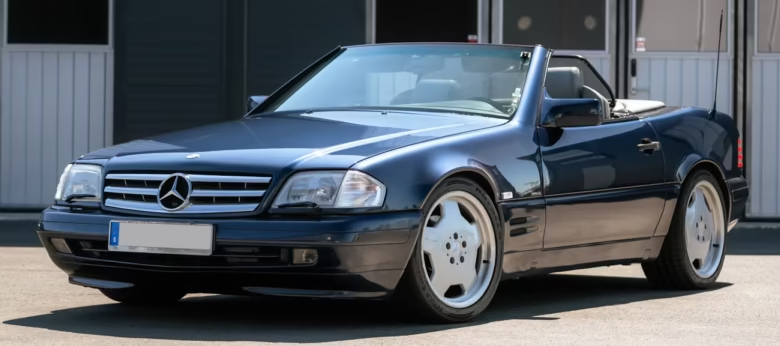
The mid-1990s were a golden era for the Mercedes SL, and 1996 was a particularly pivotal year. Just in time for the U.S. 1996 model year, the R129 SL received its first major facelift. While at first glance the changes seemed subtle, they marked an important technological and design evolution that kept the SL at the top of the luxury roadster segment.
A tailored update for the American market
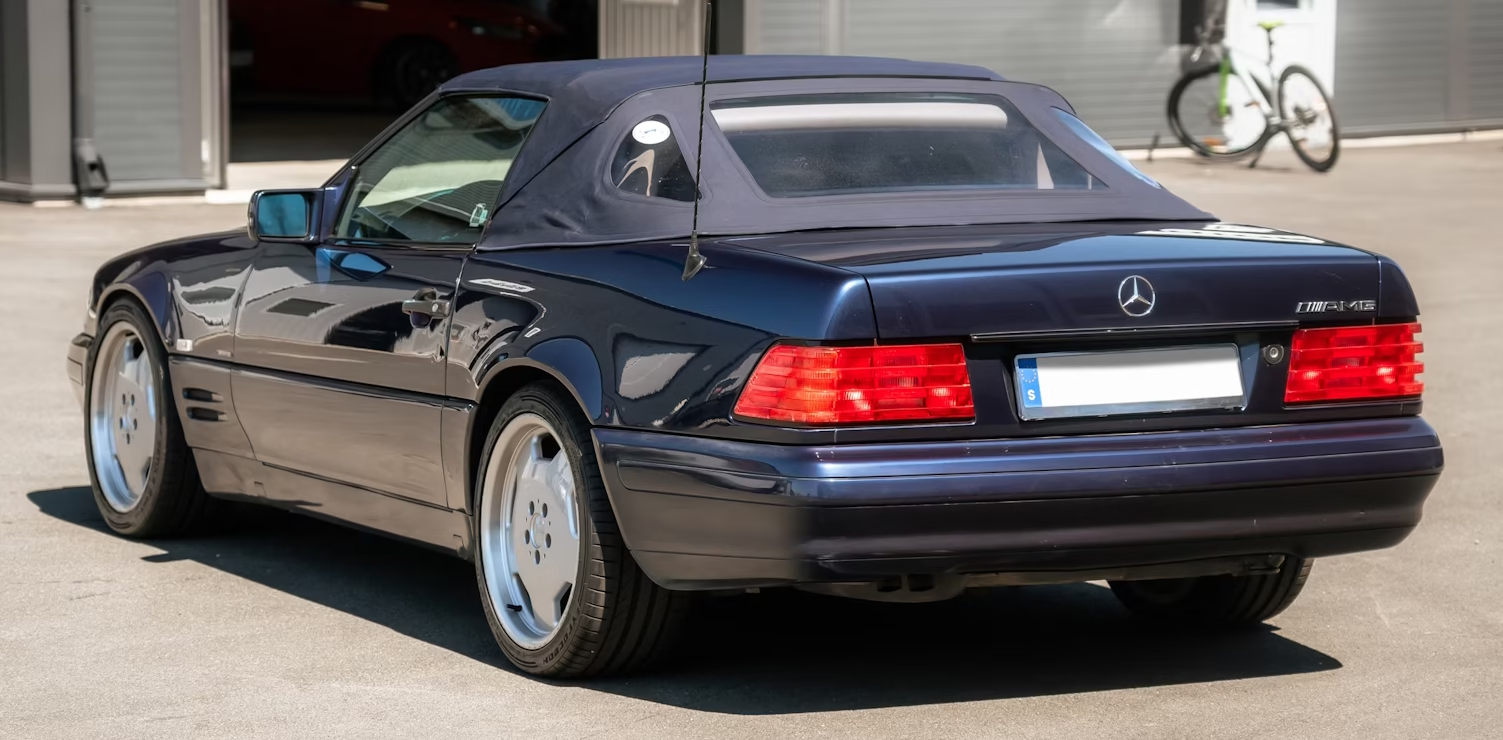
The U.S.-spec models inherited most of the revisions made to the European versions, with a few market-specific tweaks to comply with federal regulations. For example, the front indicator lens units remained unchanged to meet U.S. standards.
The pricing structure for the American lineup carried over from the previous year with only minor adjustments:
- SL320 – approx. €72,800
- SL500 – approx. €83,600
- SL600 – increased slightly to around €113,460, but now with ESP fitted as standard.
All models featured a five-speed automatic transmission, but only the V8 and V12 models initially benefited from the new 5AT gearbox.
Suspension, lighting, and comfort upgrades
The SL600 received Mercedes’ latest adaptive damping system (ADS) as standard, now featuring manual ride height adjustment for the first time on the U.S. market. Buyers of the SL320 and SL500 could opt for ADS for an additional €3,960.
Another highlight was the introduction of gas-discharge xenon headlights, also standard on the SL600. However, due to regulatory constraints, they couldn’t be combined with the headlamp wash/wipe system. For the SL320 and SL500, xenon lighting was available as a €880 option.
Comfort-oriented features expanded as well:
-
Heated seats: €550
-
Multi-contour seats: €350 per seat
-
ASR traction control for SL320: €1,120
-
ESP upgrade for SL500: €1,740
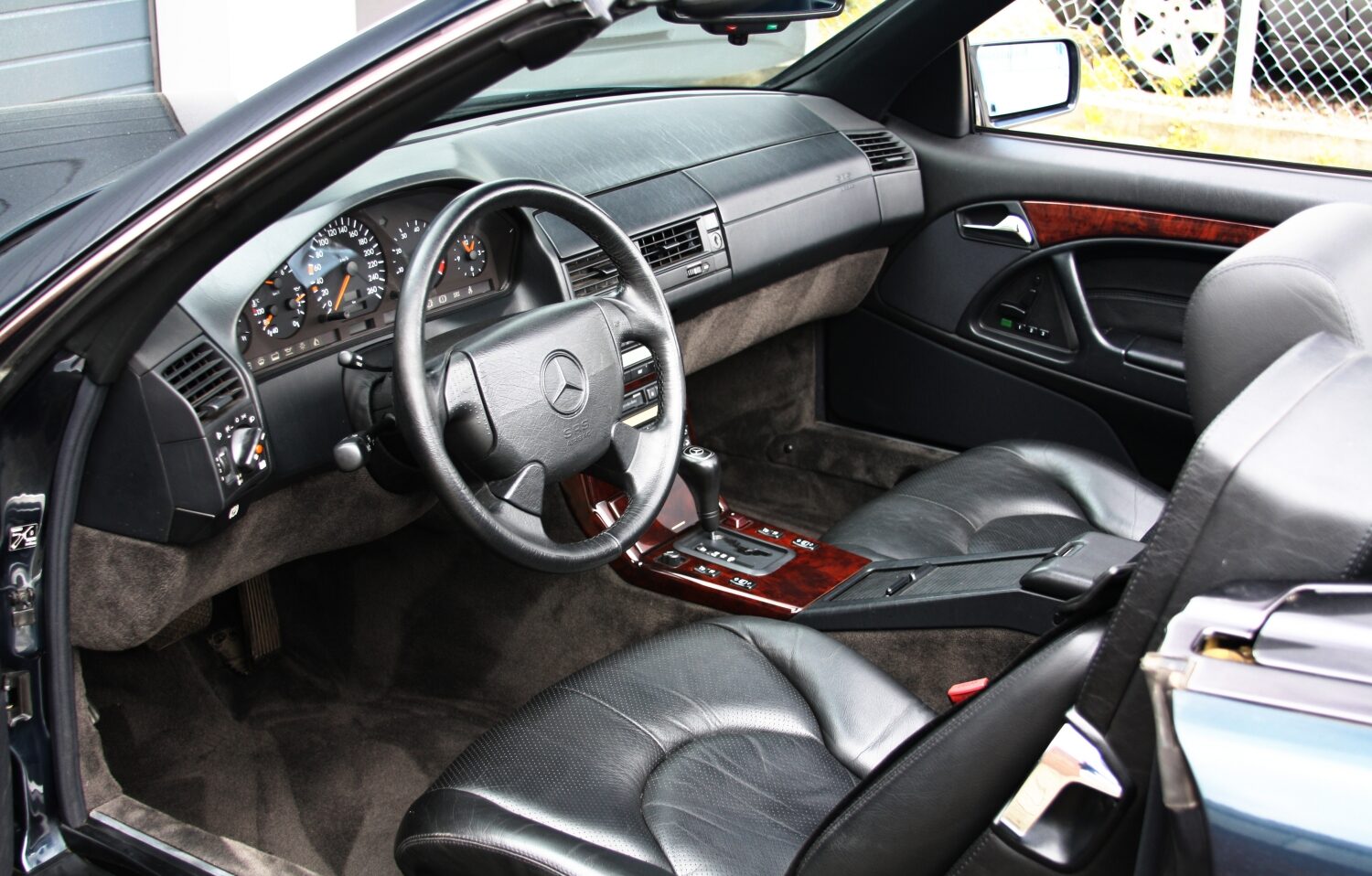
Following the example of the S600, the 1996 SL600 for the U.S. also received two-tone Exclusive leather upholstery. The refined interior design — paired with ESP and the adaptive chassis — justified the modest price increase compared to the previous model year.
Technology that looked ahead
Mercedes-Benz also brought new onboard diagnostics (OBD-II) to all U.S. SL models for 1996, a step ahead of European regulations that wouldn’t mandate the system until 2001. This upgrade allowed more accurate troubleshooting, better emissions control, and more precise vehicle testing.
Meanwhile, small but thoughtful details improved the overall user experience: grey secondary km/h speedometer markings replaced the previous orange ones (improving visibility of mph markings), cupholders became standard (a must-have in the U.S.), and floor mats were finally included in the package instead of being a €93 accessory.
Performance and market response
In an all-out performance test, Road & Track compared the SL600 against the Porsche 911 Turbo and Dodge Viper GTS. While the SL wasn’t the fastest, its silky V12, imperceptible gearshifts, and effortless character stood out. Impressively, it even beat the Chevrolet Corvette LT4 in the 0–100–0 km/h test.
Mercedes-Benz passenger car sales in the U.S. grew significantly from 76,752 units in 1995 to 90,844 in 1996. The SL line remained steady, with a slight drop of just 108 units — still accounting for 7.6% of Mercedes’ U.S. market share. Among them, around 680 units were SL600s and roughly 3,500 were SL500s.
Global pricing snapshot
In the UK, prices for the facelifted models rose slightly:
-
SL280 – approx. €66,580
-
SL320 – approx. €72,890
-
SL500 – approx. €93,950
-
AMG model – €107,040
-
SL600 – €118,950
In Japan, the SL320 debuted at around €58,800, making it a more affordable alternative to the SL500. Even Australia expanded its lineup with the SL280 at €185,700, alongside the SL500 at €265,000 and SL600 at €340,500.
Conclusion
The 1996 facelift didn’t radically change the R129 SL’s looks — it didn’t have to. What Mercedes-Benz achieved was a carefully measured upgrade: refined technology, enhanced safety, and subtle design details that reinforced the car’s status as the world’s benchmark for luxury roadsters.
Nearly three decades later, these facelifted R129 models remain some of the most desirable classic Mercedes convertibles, combining timeless design with cutting-edge (for the time) engineering.
Q: What changed on the Mercedes R129 for the 1996 model year?
A: The 1996 update brought important improvements to technology, safety, suspension and equipment rather than a dramatic visual redesign. Depending on the version and market, buyers could get features such as ESP, adaptive damping, xenon headlights, improved diagnostics and additional interior equipment.
Q: Which R129 engine is best for a buyer?
A: The answer depends on priorities. The SL320 offers a good balance of performance and running costs, the SL500 provides the classic V8 character many enthusiasts expect from an SL, while the SL600 delivers the smoothness and effortless performance of the V12 but also brings substantially greater mechanical complexity.
Q: What is ADS on the Mercedes R129?
A: ADS stands for Adaptive Damping System and controls the suspension damping to improve both comfort and stability. On the 1996 U.S.-specification SL600, the system was fitted as standard and gained manual ride-height adjustment, while it was available as an option on the SL320 and SL500.
Q: What is OBD-II and why does it matter on a 1996 R129?
A: OBD-II is an onboard diagnostic system that allows electronic systems and emissions-related faults to be monitored and diagnosed through a standardized interface. For owners, it makes fault diagnosis more systematic and can be particularly useful when maintaining an older car with increasingly complex electronics.
Q: What should I check before buying a 1996 R129?
A: Start with the condition of the body and chassis, then inspect the engine, transmission, cooling system, suspension and electrical equipment. On cars equipped with ADS or other complex options, verify that every system actually works, because repairing neglected high-spec equipment can be considerably more expensive than buying a simpler, well-maintained example.
Are you already a proud owner of a Mercedes R129? If so, check out our selection of parts for this car at the following link:
https://octoclassic.com/product-category/mercedes-benz/r129
Photo sources: collectingcars.com, nfautomotive.nl