







































Audi R8 prices in 2026: Bottomed out or last chance to buy?
 Added on: March 3, 2026
 Author: OctoClub
1. The silent shift in the Audi R8 market
4. Second generation – Modern, faster, surprisingly stable
5. Following the market – Not leading it
7. Conclusion
The silent shift in the Audi R8 market
Not long ago, the Audi R8 was riding the same wave as the rest of the performance car world. During the pandemic boom, prices surged dramatically. Demand was high, supply was tight, and buyers were willing to stretch.
Then came the correction.
From their 2022 peak, R8 prices declined – first sharply, then more gradually. But now, something interesting is happening. In both the United States and Germany, prices have stopped falling. In some segments, they’re even inching upward.
At the same time, Audi has discontinued the naturally aspirated V10 R8. Rumors suggest the model may return around 2027 – but likely without the high-revving V10 that defined its character.
That raises a serious question: have R8 prices finally bottomed out? Or is this just a pause before another move?
For first-time buyers especially, this moment feels critical. The V8 has long been a gateway into proper mid-engine performance. The V10? A clear step into supercar territory. If prices begin climbing again, today’s entry point may quietly disappear.
First generation V8

The first-generation V8 models are now the elder statesmen of the R8 family. In the U.S., both pre-facelift and facelift automatic versions followed a familiar pattern: pandemic surge, 2022 peak, then decline.
But in 2025, something changed.
Prices flatlined.
Facelift models slipped by just –0.6%, while pre-facelift cars actually rose by +1.8%. These movements aren’t statistically decisive, but they clearly show that the steep depreciation phase has ended.
In Germany, the picture is even more intriguing. Since late 2023, prices have stabilized – and in some cases crept upward. Pre-facelift V8s rose approximately +2.6% year over year, while facelifted examples showed a larger but less statistically certain increase.
Then there are the manuals.
In the U.S., manual V8 prices have remained stable since 2022. No dramatic surge – but importantly, no collapse either. Supply remains limited, especially for facelifted manual cars.
Germany tells a more dramatic story. Manual pre-facelift V8 prices surged roughly +23% last year. The market is small, so volatility is high – but the upward movement is statistically confirmed.
If there is one early signal of collector interest forming, this might be it.
The first generation V10

If the V8 is the rational choice, the V10 is the emotional one.
Looking at U.S. first-generation V10 automatics (base models), the trend mirrors the V8: decline after 2022, then flattening in 2025.
Year over year, facelift models dipped –4.2%, largely driven by higher-mileage examples. Lower-mileage cars held steady. Pre-facelift models rose +4.6%, nearly reaching statistical confirmation.
In Germany, stability is the dominant theme. Pre-facelift base models rose slightly (+2.2%), while GT variants showed stronger increases—though small sample sizes require caution.
Facelift V10s in Germany reversed earlier declines in 2025. Base models climbed +5.6%, while Plus versions rose +3.7%.
And the manual V10? Arguably the most desirable of all.
Supply in both the U.S. and Germany is extremely limited – so limited that reliable trend analysis becomes difficult. But scarcity alone tells part of the story.

Second generation – Modern, faster, surprisingly stable
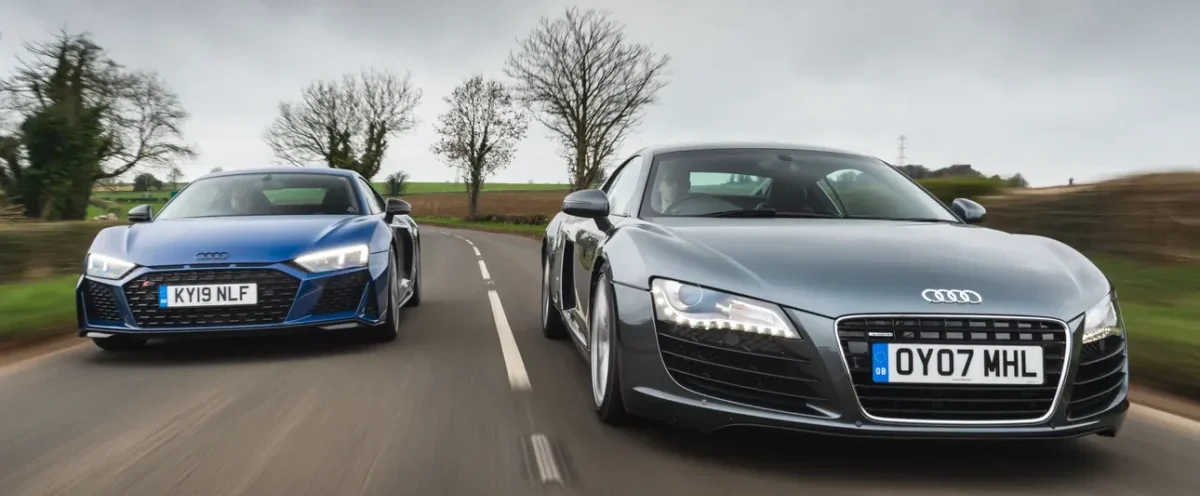
The second-generation R8 brought sharper styling and more power. It also introduced a wider mix of configurations: rear-wheel drive (2WD), quattro (4WD), Performance models, GTs, and more.
In the U.S., pre-facelift base models appear to have bottomed as early as 2024. In 2025:
-
4WD base models rose +2.4%
-
2WD base models rose +1.1%
-
Plus models increased +5.5% (statistically confirmed)
In Germany, the same models saw slight declines (–1.7% to –2.4%), though none statistically significant.
Looking at the latest facelift generation, divergence appears. In the U.S., 4WD base models rose +3%, while 2WD versions dipped –2.3%. Performance variants climbed modestly across both drivetrains.
Germany again shows a flatter pattern: small movements, mostly within statistical noise.
The key takeaway? Across generations and configurations, the dramatic depreciation phase seems to have ended.
Following the market – Not leading it
Here’s where the story becomes more nuanced.
When comparing R8 values to the broader U.S. performance car market – which includes cars like the Porsche 911, Toyota Supra, and models from Ferrari and Lamborghini – a clear pattern emerges.
The R8 hasn’t been acting independently.
It surged with the market.
It peaked in 2022.
It corrected alongside everything else.
And now it’s flattening – just like much of the enthusiast segment.
The median price change across R8 variants currently sits at approximately +2.2%. That’s not a decline. But it may not signal a true, R8-specific bottom either.
In the U.S., values appear tightly linked to broader systemic market forces.
Germany may be slightly different. Older first-generation models have shown sustained stability since late 2023, and manual V8s have clearly appreciated. That could indicate the beginning of model-specific dynamics.

Have prices bottomed?
If we’re speaking strictly about the U.S., the answer is: probably not yet in a structural sense.
Prices have flatlined – but largely because the overall market has stabilized. A true bottom would likely require R8-specific drivers: collector demand for naturally aspirated V10s, recognition of manual scarcity, or renewed enthusiasm following electrification trends.
Germany presents a stronger case for an early bottom in first-generation models. Stability has lasted longer, and manual V8 appreciation is notable.
But data limitations prevent absolute certainty.
Conclusion
This may not be the screaming bargain era of 2023. But neither does it look like the beginning of a major surge – yet.
For first-time buyers considering an R8 as their entry into serious performance machinery, the current moment feels uniquely balanced:
-
Depreciation has slowed or stopped.
-
Supply remains reasonable (except for manuals).
-
Prices, written in euro terms, remain well below pandemic highs.
If broader market conditions remain stable, R8 values may continue to hover around current levels. If idiosyncratic demand kicks in – especially for manual or naturally aspirated V10 variants – the story could change quickly.
The Audi R8 has always occupied a fascinating space: usable supercar, everyday exotic, understated but special.
With the V10 gone and the future uncertain, today’s pricing might not look so ordinary in hindsight.
Q: Is now a good time to buy an Audi R8?
A: Yes. Current market data suggests that Audi R8 prices have largely stabilized after falling from their 2022 peak. While there’s no guarantee prices will rise, depreciation has slowed significantly, making this one of the more balanced times to buy.
Q: Why did Audi R8 prices fall after 2022?
A: Like many performance and collector cars, the Audi R8 experienced unusually high demand during the pandemic. Once interest rates increased and the market normalized, prices corrected across the sports car segment, including the R8.
Q: Which Audi R8 is the best investment?
A: Manual first-generation V10 models are generally considered the most collectible because of their rarity and naturally aspirated engine. Manual V8s also show promising appreciation, particularly in the European market.
Q: Should I buy an Audi R8 V8 or V10?
A: Choose the V8 if you’re looking for better value, lower running costs, and an enjoyable driving experience. Choose the V10 if you want the iconic naturally aspirated supercar experience and potentially stronger long-term collector appeal.
Q: What is the difference between first-generation and second-generation Audi R8 models?
A: The first generation focuses on a more analog driving experience and offers manual transmission versions. The second generation is faster, more technologically advanced, and available in multiple configurations including rear-wheel drive, quattro, Performance, and GT variants.
Inspired by the analysis of our friend @fourwheeltrader. Make sure you check his other videos
https://www.youtube.com/@fourwheeltrader
Are you already a proud owner of a Audi R8? If so, check out our selection of parts for this car at the following link:
https://octoclassic.com/product-category/audi/r8-audi
Photos sources: ar.inspiredpencil.com, animalia-life.club, Top Gear, thesun.ie