













































C8 Corvette prices drop — But is now the right time to buy?
 Added on: July 9, 2025
 Author: OctoClub
1. What happened to the Corvette C8 market?
4. Signs of market stabilization
5. What about the Corvette Z06?
6. How the C8 compares to the rest of the market
7. Conclusion
What happened to the Corvette C8 market?
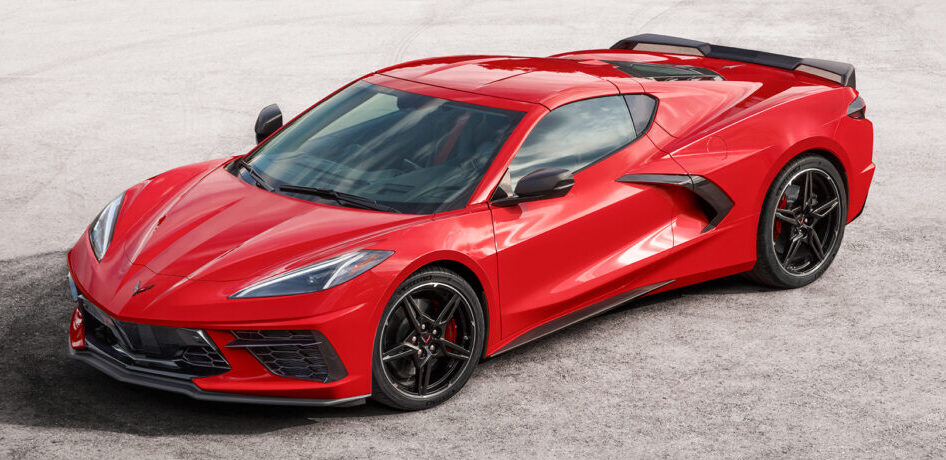
To understand why prices have taken such a hit, we need to go back a few years. During the pandemic, the C8 Corvette Stingray became one of the most in-demand vehicles in the U.S. — so popular, in fact, that the average time to sell one was just 7 days. Naturally, this demand drove prices into the stratosphere.
But as supply began to increase — hitting nearly 1,000 available units by August 2021 — the market cooled. Prices began to fall. By the end of 2022, coupe prices had dropped by €10,000 and convertibles by €12,000 in just six months. Although the pace of depreciation has slowed since, it has consistently remained above the market average.
What’s happening in 2025?
Fast forward to spring 2025, and we see something unusual: prices slightly increased between February and May. Coupes rose to a median of €64,000, while convertibles climbed to €72,000. While that may seem promising, it’s largely due to seasonal effects, not a long-term trend.
Historically, C8 prices stabilize or increase slightly in spring and summer, only to fall again in winter. So, if you’re buying now, you’re paying the highest seasonal premium — and getting the least amount of discount.

No room to negotiate
One critical reason not to buy a C8 this summer is the lack of negotiation room. In winter 2023, unsold C8s sat on lots for months, prompting average discounts of around 7%. But in spring and summer, especially this year, sellers know they can wait. Discounts on unsold cars currently average just 0–1% — virtually no wiggle room.
Wait until winter, and you could knock off €3,500 to €4,500 just through seasonal discounts alone — enough to cover much of the annual depreciation.
Signs of market stabilization
While now may not be the best time to buy, it’s not all bad news. The C8 market is slowly stabilizing:
-
Depreciation rates for Stingrays have decreased to 8–9% annually, down from 12–14% previously.
-
The inventory turnover rate has improved: only 17% of C8s remain unsold after 3 months, compared to a market average of 30%.
-
Price trends are less volatile than they were between 2021 and 2023.
What about the Corvette Z06?

The C8 Z06 follows a similar, albeit more extreme, trend. It depreciated at a whopping 16.7% for coupes and 18.1% for convertibles last year. The reason? Unrealistically high launch prices in 2023. Fortunately, newer models entered the market at more reasonable levels in 2024 and 2025, bringing depreciation under control.
Discounts on the Z06 have also normalized: down from 12% last year to just 4% now. Inventory data confirms the trend — cars are selling slightly quicker, and price deflation has slowed significantly.
How the C8 compares to the rest of the market
Let’s zoom out. Across the U.S. sports and performance car market:
-
The average annual price decrease was 3%
-
Most cars lost between 1% and 9%
-
The C8 Stingray sits above average in depreciation
-
The C8 Z06 ranks among the top 25% fastest depreciating cars
-
The C7 Z06, on the other hand, ranks in the top 20% with the lowest depreciation
Conclusion
If you’re looking for the best deal, summer 2025 is not the time to buy a C8 Corvette. Seasonal price increases, minimal discounts, and lingering depreciation risks make winter a much better time to make your move.
That said, the C8 market is showing signs of normalization, and depreciation is slowing. If you care about long-term value retention, C7 models — especially the Z06 and Grand Sport — offer much stronger fundamentals.
Q: Why did Chevrolet Corvette C8 prices rise so sharply during the pandemic?
A: Strong demand, limited availability and production constraints created a shortage of C8 Corvettes, allowing dealers and sellers to command significant premiums above original retail prices.
Q: What factors influence the depreciation of a Corvette C8?
A: Depreciation depends on production numbers, vehicle condition, mileage, specification, demand and the availability of newer models. Market supply and buyer interest also play an important role.
Q: Does the Corvette C8 Stingray hold its value well?
A: The C8 Stingray offers impressive performance for its class, but its relatively high production volume and broader availability can make it more susceptible to depreciation than rarer Corvette variants.
Q: Why does the Corvette C8 Z06 depreciate differently from the Stingray?
A: The Z06 features a naturally aspirated 5.5-litre flat-plane-crank V8, a more track-focused chassis and distinctive engineering. However, its higher initial price and changing market demand can also lead to greater depreciation.
Q: What makes the Corvette C7 Z06 attractive to collectors?
A: The C7 Z06 combines a supercharged 6.2-litre V8, rear-wheel drive and a traditional front-engine layout. Its performance, distinctive character and position as a high-performance version of the previous Corvette generation contribute to its appeal.
Q: Is the Corvette C8 available as both a coupe and a convertible?
A: Yes. The C8 Stingray and Z06 are available in coupe and convertible configurations. The coupe features a removable roof panel, while the convertible has a power-operated retractable hardtop.
Q: What should you check before buying a used Corvette C8?
A: Check the vehicle’s service history, accident records, mileage, transmission operation, suspension, brakes and tyre condition. For cars used on track, pay particular attention to signs of intensive use and possible mechanical wear.
Inspired by the analysis of our friend @fourwheeltrader. Make sure you check his other videos https://www.youtube.com/@fourwheeltrader/featured.
Are you already a proud owner of a Corvette? If so, check out our selection of parts for this car at the following link:
https://octoclassic.com/product-category/chevrolet/corvette
Photos sources: Automobile, hdqwalls.com, Bring a Trailer