



















































FDM vs MJF: Which Is Stronger?
 Added on: October 3, 2026
 Author: OctoClub
1. Why does 3D printing technology affect part strength?
2. Why are clips and mounting parts a good example?
3. What happens when a part is exposed to repeated stress?
4. Why does MJF offer more consistent mechanical properties?
5. Does the same 3D model always produce the same quality part?
Why does 3D printing technology affect part strength?
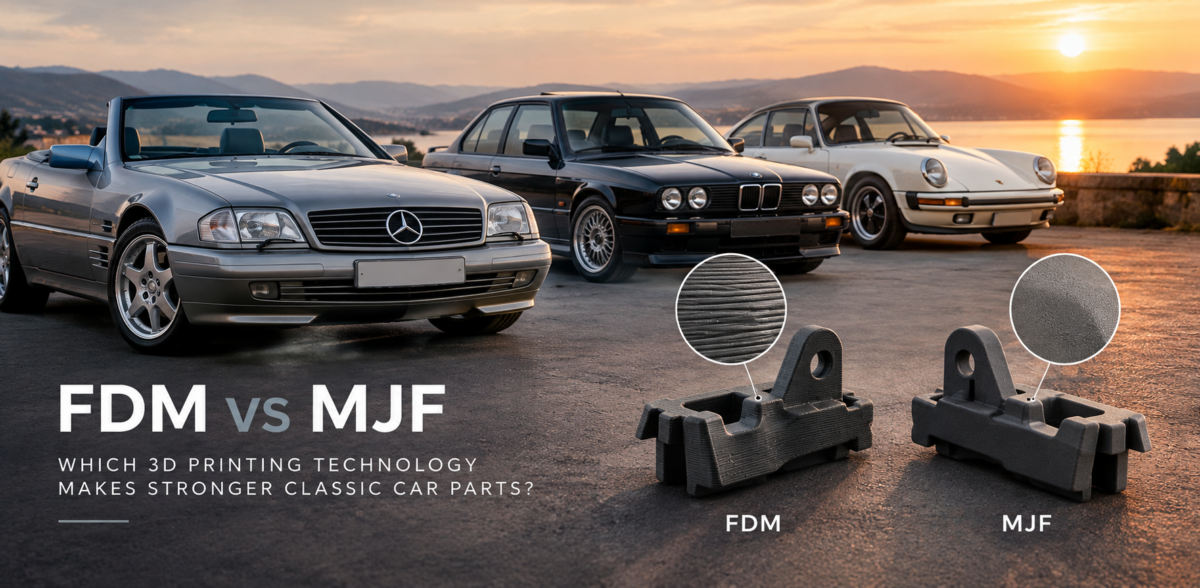
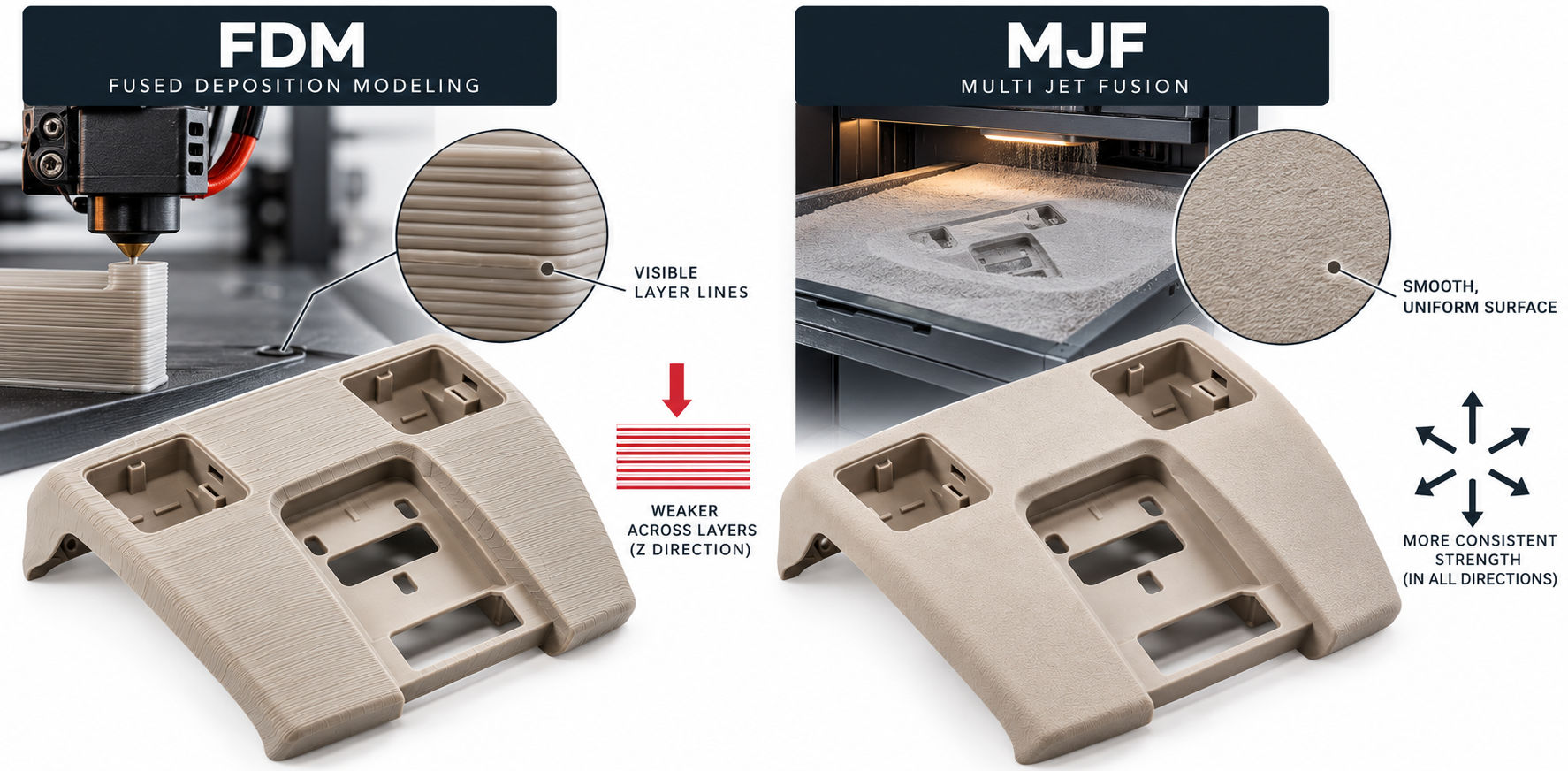
FDM creates a part by extruding molten thermoplastic layer by layer. Each new layer must bond to the one beneath it.
This layer-by-layer construction means that the mechanical properties of an FDM component can vary depending on its build orientation, geometry, material and layer adhesion.
The weakest direction is often across the individual layers, because the bond between layers is not identical to the strength of the material within a continuous extrusion path.
For a decorative component, this may not be particularly important. For a mounting tab, clip or bracket that is repeatedly flexed or loaded, it can become a significant design consideration.
MJF uses a different approach. Instead of depositing a plastic filament, it processes a bed of polymer powder using fusing and detailing agents combined with controlled heat.
The result is a component with more consistent mechanical properties in different directions than a typical FDM part.
The important point is simple: 3D printing is not one manufacturing technology. The printing process itself can influence how a finished part behaves.
Why are clips and mounting parts a good example?
Classic cars contain hundreds of small plastic components that experience surprisingly high loads.
A door-panel clip, for example, may appear insignificant. In reality, it can experience:
- repeated insertion and removal
- bending during installation
- vibration while driving
- temperature changes
- pressure from surrounding trim
- ageing of neighbouring materials
This is why a replacement clip that looks perfect when new can still fail quickly if its material or manufacturing method is poorly suited to the application.
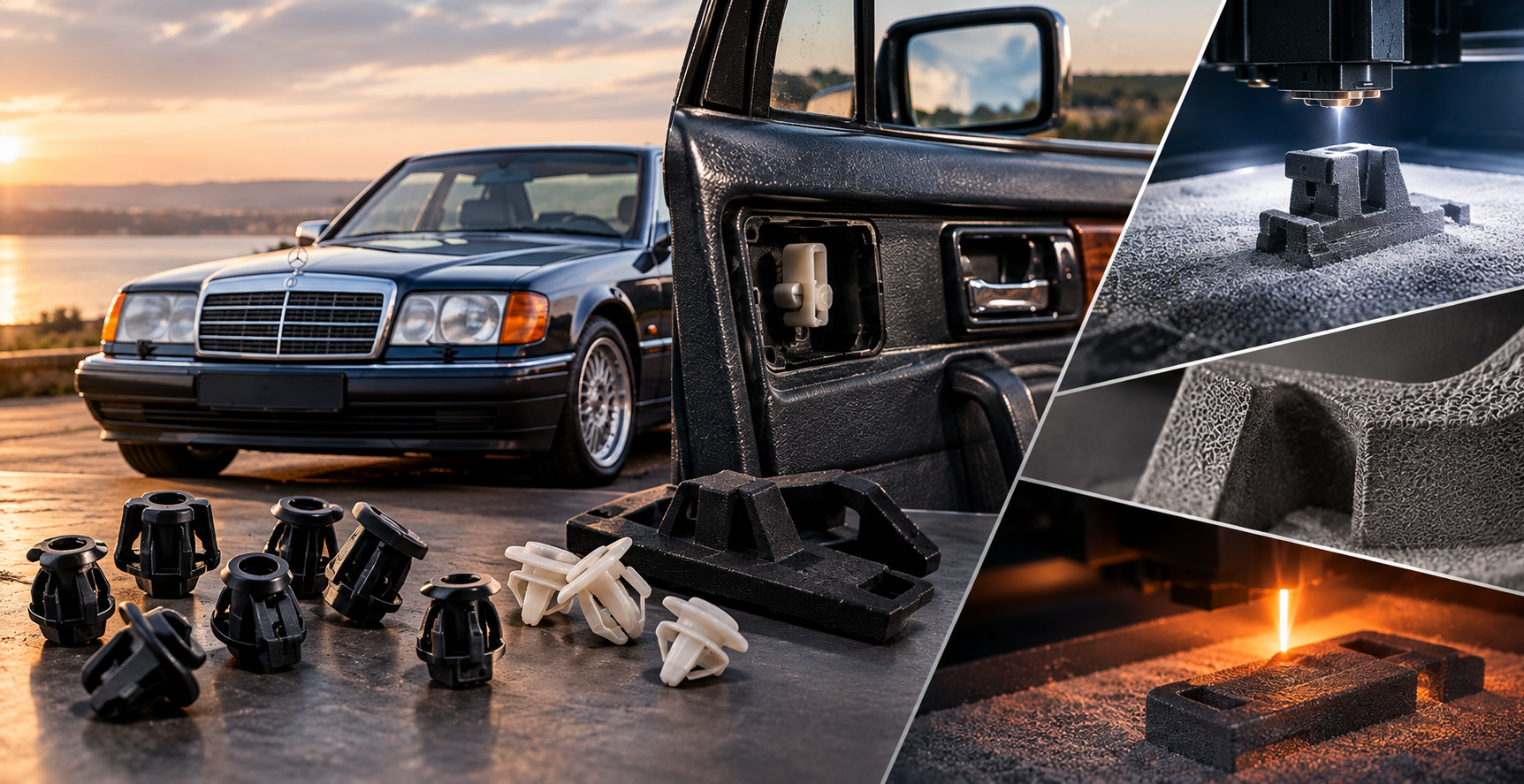
A good example is the Mercedes W124 Rear Door Panel Clip Repair Kit, designed as a replacement for damaged or missing original mounting clips.
The component is manufactured using laser sintering with polymer powder, rather than conventional filament-based FDM printing. This type of industrial powder-bed manufacturing allows complex small components to be produced without relying on the layer-by-layer filament structure characteristic of FDM.
For classic-car restoration, this distinction matters because these parts are not simply decorative. They are functional components that need to survive repeated use.
What happens when a part is exposed to repeated stress?
A component does not necessarily break because one load is too large.
Many plastic parts fail because they experience repeated loading over time.
Consider a seat switch cover or mounting clip. Every time the component is touched, moved, installed or removed, small stresses can accumulate. If the part contains a weak area – for example, a thin section, sharp internal corner or poor layer bond – repeated loading can eventually produce a crack.
This is particularly relevant to classic cars because many original plastic components have already spent decades exposed to:
- heat
- sunlight and UV radiation
- temperature cycling
- vibration
- repeated mechanical use
A replacement part therefore needs more than the correct dimensions. Material selection, wall thickness, geometry and manufacturing technology all contribute to its long-term performance.
For example, OctoClassic’s Mercedes R129 Seat Switch Cover uses polymer-powder laser sintering and PA12 material. The design has also been upgraded in areas that are commonly damaged, with additional thickness intended to improve resilience.
The same principle is used with the Mercedes W124 E500 Seat Switch Cover, where the replacement is produced using PA12 and the design has been reinforced in areas that are particularly prone to damage.
This illustrates an important engineering principle:
A stronger replacement is not created simply by copying the original shape. The material and design can also be improved where the original component was vulnerable.
Why does MJF offer more consistent mechanical properties?
One of the major advantages of powder-based technologies such as MJF is the ability to produce parts with more uniform mechanical behaviour than conventional layer-by-layer filament printing.
In FDM, the orientation of the part during printing can significantly influence its strength. A component may therefore perform differently depending on whether a load is applied parallel or perpendicular to the deposited layers.
MJF does not rely on individual filament lines being mechanically bonded together in the same way.
Instead, polymer powder is selectively fused throughout each layer. For applications requiring functional plastic components, this can provide more consistent properties and predictable behaviour.
This is one reason industrial powder-bed technologies are used for functional components such as:
- clips
- brackets
- housings
- covers
- mounts
- guides
- connectors
However, MJF does not mean that a part is impossible to break. No 3D-printing technology can compensate for an unsuitable material, insufficient wall thickness, poor geometry or excessive mechanical load.
The engineering of the component still matters.
Does the same 3D model always produce the same quality part?
No – and this is one of the most important things to understand when comparing 3D-printed automotive parts.
Two manufacturers can use the same CAD model and produce parts that look almost identical but perform differently.
The final result depends on several factors:
Material: Different polymers have different strength, stiffness, temperature resistance and ageing characteristics.
Manufacturing technology: FDM, MJF and other powder-bed processes create the final structure in different ways.
Part orientation: Particularly important for FDM because mechanical properties can be strongly direction-dependent.
Wall thickness: A thin replacement component can fail even when produced using a high-quality manufacturing process.
Geometry: Sharp corners, thin tabs and stress concentrations can become failure points.
Post-processing: Surface finishing and other post-processing steps can influence the final appearance and, depending on the application, dimensional characteristics.
This is why simply seeing the words “3D printed” on a product description tells you very little about its actual engineering quality.
For classic-car owners, the better question is not:
“Is this part 3D printed?”
It is:
“What material was used, how was it manufactured, and was the part designed for the loads it will actually experience?”
Are you already a proud owner of a Classic car? If so, check out our selection of parts for this car at the following link: