























































FDM vs MJF: Why Classic Car Parts Need More Than Just a Perfect Fit
 Added on: October 10, 2026
 Author: OctoClub
1. Why does heat damage classic car plastics?
2. How does UV radiation accelerate plastic ageing?
3. Why do original plastic parts become brittle after decades?
4. Does MJF or powder-based 3D printing automatically make a part heat and UV-resistant?
5. What should you look for in a replacement part for a classic car?
Why does heat damage classic car plastics?
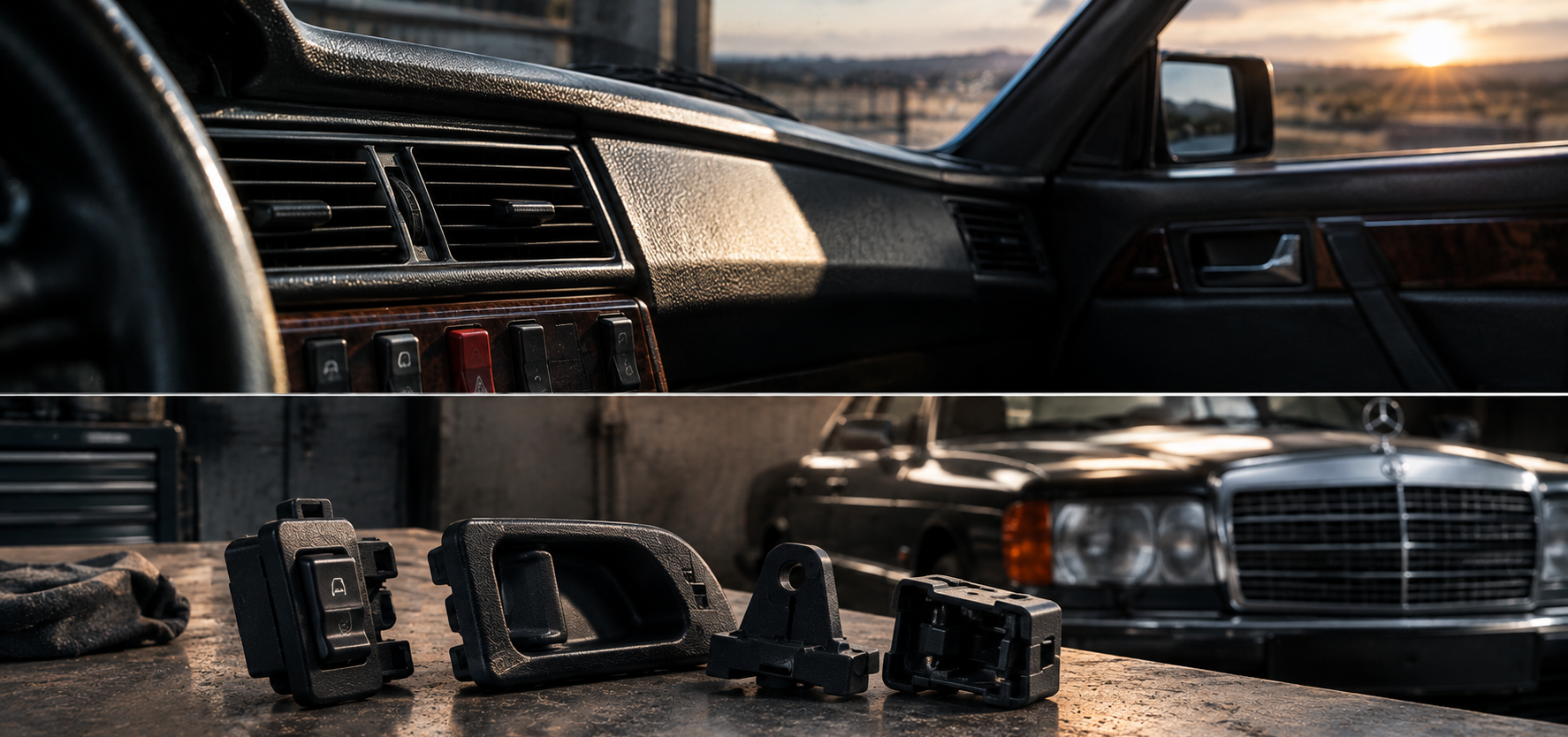
The interior of a parked car can become significantly hotter than the surrounding air, especially in direct sunlight. Dashboard components, switch covers and trim pieces may repeatedly experience elevated temperatures as the car heats up and cools down.
Heat can affect plastics in several ways. Depending on the material, temperature and exposure time, it can reduce stiffness, accelerate ageing or increase the risk of deformation. A component under constant stress may be particularly vulnerable.
The important factor is not simply the highest temperature reached. Repeated heating and cooling can also contribute to material fatigue and changes in dimensional stability.
For example, a plastic cover fitted tightly around a switch may expand when hot and contract as it cools. If the design leaves insufficient clearance or concentrates stress around small mounting tabs, these repeated changes can contribute to cracking or loss of fit.
When choosing replacement parts, consider the intended operating environment. A component designed for a cool interior or occasional use may not be suitable for a location exposed to intense sunlight and prolonged heat.
How does UV radiation accelerate plastic ageing?
Sunlight does more than heat a car’s interior. Ultraviolet radiation can trigger chemical changes in susceptible polymers, gradually affecting their appearance and mechanical properties.
Depending on the polymer formulation and stabilising additives, prolonged UV exposure may cause:
- fading or colour changes
- surface deterioration
- loss of toughness
- increased brittleness
- a greater tendency to crack under mechanical stress
These effects are especially relevant to exposed dashboard trim, seat switch covers, exterior plastic caps and other components that receive regular sunlight.
However, not all plastics respond to UV radiation in the same way. The result depends on the polymer, its formulation, any UV stabilisers or protective coatings, and the intensity and duration of exposure. Research into FDM materials also demonstrates why UV exposure should be evaluated for the specific material rather than assumed to have the same effect on every printed part.
This leads to an important distinction: a smooth surface and a premium appearance do not automatically mean that a part has good UV resistance.
If a component will remain exposed to sunlight, its material and any protective finish should be appropriate for that environment.
Why do original plastic parts become brittle after decades?
Many classic cars were designed around plastics that performed well when new. After 20, 30 or more years, however, the same components may have experienced thousands of temperature cycles, prolonged exposure to sunlight, chemical contact and repeated mechanical loads.
Ageing is not caused by a single universal process. Some plastics lose impact resistance; others may experience oxidation, changes in molecular structure or degradation associated with heat and light. Plasticisers can migrate from certain formulations, while stress and environmental exposure can accelerate cracking in susceptible materials.
The consequences are familiar to restoration enthusiasts: a retaining tab snaps during removal, a switch cover develops a crack, or an old trim piece breaks even when handled carefully.
A replacement should therefore be evaluated as a new engineered component, not merely as a copy of an ageing original.
This is relevant because material choice and component geometry can address different failure mechanisms. A suitable polymer can offer a useful balance of toughness and strength, while a carefully revised design can reduce vulnerability around known weak points.
Neither measure makes a component immune to ageing, but both can contribute to a better-engineered replacement.
Does MJF or powder-based 3D printing automatically make a part heat and UV-resistant?
No. Manufacturing technology and environmental resistance are related, but they are not interchangeable.
MJF (Multi Jet Fusion) and laser sintering are powder-bed manufacturing processes. They differ from FDM, which deposits molten thermoplastic filament layer by layer. Powder-bed processes can produce functional components with consistent geometry and useful mechanical properties, but the final performance still depends on the specific material, manufacturing parameters and part design.
It is particularly important not to confuse mechanical strength with resistance to environmental ageing.
A component may be strong under room-temperature testing but behave differently after prolonged heat exposure. Likewise, a material with good mechanical properties may still require suitable UV stabilisation or a protective finish if it is intended for long-term outdoor use.
When assessing a replacement part, distinguish between these properties:
- Heat resistance: the temperatures the material can tolerate while maintaining the required performance.
- UV resistance: how well the material retains its appearance and properties after ultraviolet exposure.
- Thermal cycling resistance: how the component handles repeated temperature changes.
- Mechanical durability: how well it withstands loads, impacts and repeated use.
- Dimensional stability: whether it retains the shape and fit required for its application.
These properties should ideally be supported by material data or relevant testing. The name of a printing process alone is not enough to establish them.
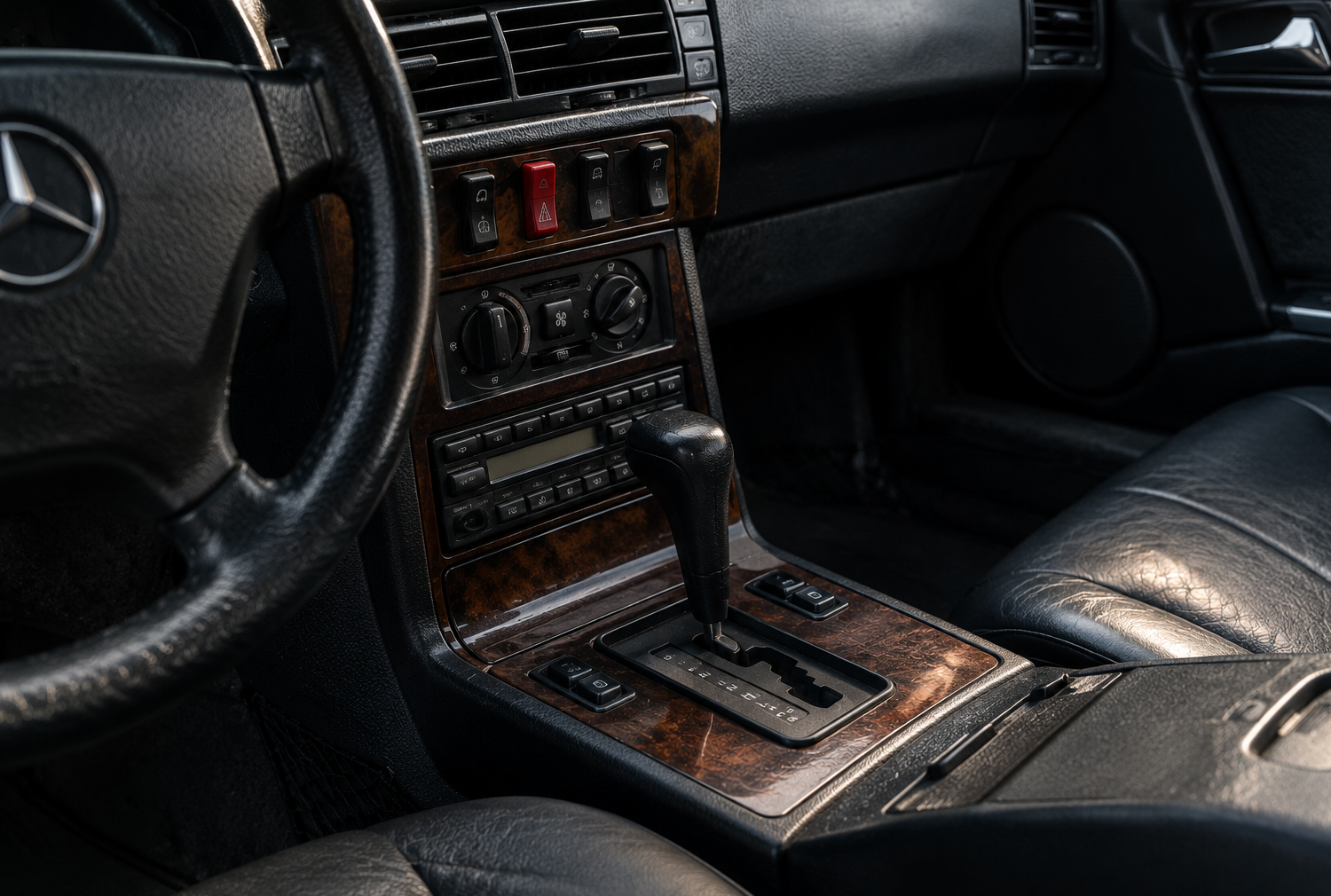
What should you look for in a replacement part for a classic car?
Before buying a replacement plastic component, consider where it is installed and what it must withstand.
A hidden interior mounting bracket has different requirements from a dashboard trim piece exposed to direct sunlight. An exterior cap may face rain, UV radiation and temperature fluctuations, while a switch cover may experience frequent contact and localised mechanical stress.
A practical checklist includes:
- Material: Is the polymer suitable for the component’s intended environment?
- Temperature range: Can it tolerate the expected operating and storage temperatures?
- UV exposure: Is UV resistance relevant, and is it supported by material information or testing?
- Design: Have thin sections, mounting tabs and other vulnerable areas been considered?
- Finish: Is the coating or surface treatment appropriate for the intended use?
- Fit and installation: Are the dimensions correct, and can the part be installed without excessive force?
For restoration projects, colour matching and surface finish also matter, especially for visible interior components. However, these should complement the engineering requirements rather than replace them.
At OctoClassic, selected replacement components are produced using industrial powder-based manufacturing, and some designs use PA12 with reinforcements in areas prone to damage. The exact material and manufacturing process should always be checked on the individual product page.
The goal is not simply to make a part that fits today. It is to choose a component whose material and design are appropriate for the conditions it will encounter.
Q: Why do classic car plastic parts become brittle?
A: Long-term exposure to heat, UV radiation, oxygen and repeated mechanical stress can change a polymer’s properties. The rate and type of deterioration depend on the material formulation and the environment.
Q: Can a stronger replacement design last longer than the original?
A: It can, if the revised geometry addresses a genuine weakness and the material is suitable for the application. Reinforcing a vulnerable mounting tab, for example, may improve durability, but excessive thickness or poor geometry can introduce other problems.
Q: What is more important: the material or the manufacturing method?
A: Neither should be considered in isolation. Material properties, manufacturing quality, component geometry and the intended environment work together to determine performance.
Are you already a proud owner of a Classic Car? If so, check out our selection of parts for this car at the following link: